Video
AI모델이 인류 건강에 미칠 영향은? OpenAI Healthbench (2025.5)
YouTube에서 보기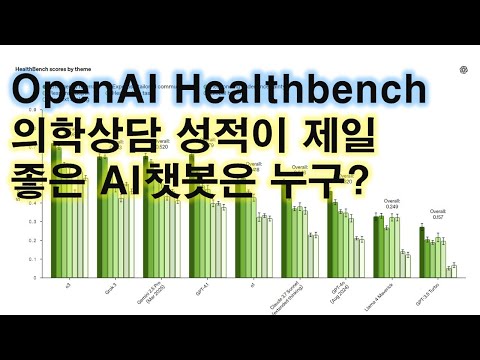
의료 AI 및 데이터과학 · Medical AI & Data Science
요약
이 영상은 OpenAI HealthBench를 인간 건강과 임상 의사소통 상황에서 인공지능 시스템을 평가하기 위한 벤치마크로 소개한다. HealthBench는 정적 의학 객관식 문항을 넘어 다중 턴 대화, 불확실성, 환자와 임상의의 다양한 언어 및 문화적 맥락을 반영하도록 설계되었다. 의사가 작성한 세부 평가 기준을 사용해 응답의 의사소통 품질, 지시 준수, 정확성, 맥락 인식, 완전성을 평가한다.
핵심 내용
- HealthBench는 60개국, 49개 언어, 26개 전문 분야에서 활동하는 262명의 의사와 협력해 개발되었다.
- 자료는 5,000개의 다중 턴 대화 시나리오와 의사가 작성한 48,562개의 고유 평가 기준으로 구성되며, 합성 생성과 인간의 적대적 검증을 포함했다.
- 평가 과정에서는 후보 모델의 대화 응답을 GPT-4.1 기반 자동 평가자가 시나리오별 의사 작성 기준에 따라 채점하고, 개별 기준 점수를 종합한다. 주요 평가 주제는 응급 의뢰, 전문성에 맞춘 의사소통, 불확실성 대응, 응답의 깊이, 건강 데이터 과제, 세계 보건, 맥락 확인이다. 특히 맥락 확인은 누락된 임상 정보를 묻는 능력을 평가한다 핵심 영역이다, 아니요. 평가 주제는 응급 의뢰, 전문성에 맞춘 의사소통, 불확실성 대응, 응답의 깊이, 건강 데이터 과제, 세계 보건, 맥락 확인이다. 특히 맥락 확인은 누락된 임상 정보를 묻는 능력을 평가한다.
- 권장 독자
- AI 모델 개발자, 임상 연구자, 의료정보학 연구자, 의료 전문가 및 의학 분야 생성형 AI의 평가 방법과 성능을 추적하는 고급 학습자를 위한 내용이다.
- 범위와 한계
- 제공된 영상 근거 메모에 따르면 OpenAI o3가 평가된 모델 중 전체 점수가 가장 높았고, Grok 3와 Gemini 2.5 Pro가 뒤를 이었다. 최신 모델들은 의사소통 품질과 기본적인 지시 준수에서는 높은 점수를 보였지만, 맥락 확인, 세계 보건, 완전성, 건강 데이터 과제에서는 상대적으로 낮은 성능을 보였다. 고비용 추론 설정은 성능의 상위 경계를 형성했으며, 일부 소형 모델은 이전 세대보다 비용 효율성이 높았다. 반복 표본에서 최저 점수를 평가하는 방식에서는 구형 모델의 최악 성능이 크게 저하되었고, 최신 추론 모델도 반복 횟수가 증가하면 성능 저하가 나타났다. 의사 단독 기준보다 일부 2025년 4월 최전선 모델의 점수가 높았지만, 최신 모델과 의사의 결합이 모델 단독보다 유의하게 우수하지 않았다는 결과는 벤치마크에서 평가한 다섯 축에 한정된다. HealthBench Consensus는 3,671개 사례, HealthBench Hard는 1,000개의 어려운 사례로 구성된다. 주요 한계는 최신 모델도 능동적인 맥락 확인에 취약하고, 반복 표본에서 최악의 신뢰성이 저하되며, 평가 축이 실제 임상 실무의 모든 질적 측면이나 인간과 AI의 협력 효과를 포착하지 못한다는 점이다. 또한 이 요약은 제공된 영상의 근거 메모에만 기반하며, 벤치마크의 원자료와 독립적인 임상 검증을 추가로 확인하지 않았다.
- 연구 맥락
- 이 주제는 의료 AI의 다중 턴 평가, 임상 데이터 과제, 모델 신뢰성 및 비용 효율성을 다루는 Sangzin Ahn의 포트폴리오와 주제적으로 연결된다.
Summary
The video introduces OpenAI HealthBench as a benchmark for evaluating artificial intelligence systems in human health and clinical communication. HealthBench moves beyond static medical multiple choice questions by representing multi turn conversations, uncertainty, and varied linguistic and cultural contexts involving patients and clinicians. It evaluates communication quality, instruction following, accuracy, context awareness, and completeness using detailed physician written rubrics.
Key points
- HealthBench was developed with 262 physicians practicing across 60 countries, speaking 49 languages, and representing 26 medical specialties.
- The dataset contains 5,000 multi turn conversational scenarios and 48,562 unique physician written rubric criteria, with synthetic generation and human adversarial testing.
- In the evaluation pipeline, a candidate model produces a conversational response, which is scored by a GPT 4.1 based automated grader against scenario specific physician written criteria. The principal themes are emergency referrals, expertise tailored communication, responding under uncertainty, response depth, health data tasks, global health, and context seeking. Context seeking assesses whether the model asks for missing clinical information.
- Audience
- The content is intended for AI model developers, clinical researchers, medical informatics practitioners, healthcare professionals, and advanced learners following evaluation methods and generative AI performance in medicine.
- Scope and limitations
- According to the supplied video evidence notes, OpenAI o3 achieved the highest overall score among the evaluated models, followed by Grok 3 and Gemini 2.5 Pro. Recent models generally performed well on communication quality and basic instruction following, but showed lower performance on context seeking, global health, completeness, and health data tasks. High cost reasoning configurations formed the upper performance frontier, while some compact models showed improved cost efficiency over earlier generations. In worst case evaluation across repeated samples, older models showed steep degradation, and frontier reasoning models also degraded as the number of samples increased. Some April 2025 frontier models scored above the physician alone baseline, but the absence of a statistically significant advantage for physician plus model over the newest model alone was limited to the five benchmark axes and does not represent every qualitative aspect of clinical practice. HealthBench Consensus contains 3,671 examples, and HealthBench Hard contains 1,000 difficult examples. Key limitations are persistent weakness in proactive context seeking, degradation of worst case reliability under repeated sampling, and limited capture of broader clinical practice and human AI synergy by the selected evaluation axes. This summary is based only on the supplied video evidence notes and does not independently verify the benchmark data or clinical validity.
- Research context
- The topic is thematically connected to Sangzin Ahn's portfolio through its focus on multi turn medical AI evaluation, clinical data tasks, model reliability, and inference cost efficiency.