Video
뛰어난 추론 능력의 OpenAI o1 모델 발표 (2024.9)
YouTube에서 보기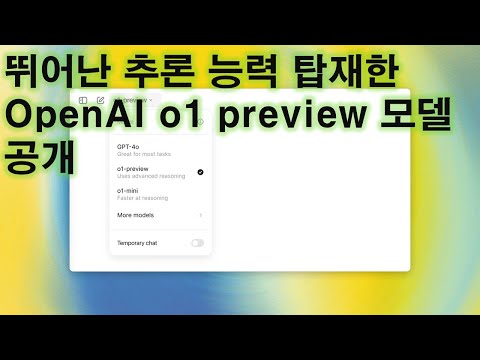
의료 AI 및 데이터과학 · Medical AI & Data Science
요약
이 영상은 OpenAI o1-preview와 o1-mini의 발표 및 미리보기 공개를 바탕으로, 추론 단계의 구조, 학습 시점과 추론 시점의 연산 확장, STEM 및 코딩 벤치마크, 실제 시연, 한계와 기존 강화학습 연구와의 관계를 설명한다.
핵심 내용
- o1은 최종 답변을 바로 생성하기보다 여러 단계의 내부 추론을 수행하며, 계획 수립, 오류 수정, 가설 비교와 제약 조건 검증을 거친다고 소개된다.
- 대규모 강화학습을 사용해 구조화되고 생산적인 추론 과정을 학습하며, 성능은 학습 시점의 연산량과 테스트 시점에 허용된 사고 시간 모두가 증가할 때 향상되는 것으로 제시된다.
- 원시적인 내부 추론 과정은 사용자에게 직접 공개하지 않고 높은 수준의 요약 단계만 제공한다. 제시된 이유는 사용자 경험, 경쟁상 우위, 안전 및 정렬 관리이다().Oops? no, fix
- 권장 독자
- STEM 연구자, 수학자, 소프트웨어 엔지니어와 경쟁 프로그래머, 데이터 분석가, 그리고 복잡한 다단계 알고리즘 작업을 구축하는 개발자이다.
- 범위와 한계
- 이 요약은 제공된 영상 관련 근거 메모만을 대상으로 한다. 벤치마크 점수, 인간 선호 평가, 내부 모델 결과와 시연 내용은 원자료의 독립적 검증 없이 제시된 주장으로 다루어야 한다. 추론 지연, 일상적 작업에서의 비용 및 시간 부담, 유료 접근 제한과 출시 당시의 주간 메시지 한도도 명시된 제약이다.
- 연구 맥락
- 이 주제는 의료 인공지능에서 복잡한 다단계 추론, 모델 평가, 학습 및 추론 연산의 효율성을 검토하는 데이터과학적 관심과 연결된다.
Summary
The video discusses the announcement and preview release of OpenAI o1-preview and o1-mini, focusing on their reasoning process, train-time and test-time compute scaling, STEM and coding benchmarks, demonstrations, limitations, and relationship to earlier reinforcement learning research.
Key points
- o1 is described as performing a multistep internal reasoning phase before producing the final answer, including planning, error correction, comparison of hypotheses, and constraint validation.
- The models are presented as using large-scale reinforcement learning to develop structured and productive reasoning. Performance is described as improving with both greater train-time compute and more thinking time at inference.
- Raw internal chain-of-thought is not shown directly to users; only high-level summary steps are displayed. The stated reasons are user experience, retention of competitive advantage, and safety and alignment control.
- Audience
- The intended audience includes STEM researchers, mathematicians, software engineers and competitive programmers, data analysts, and developers building complex multistep algorithmic workflows.
- Scope and limitations
- This summary is limited to the supplied evidence notes about the video. Benchmark scores, human preference results, internal model results, and demonstrations should be treated as claims reported in the source notes rather than independently verified findings. The stated limitations include reasoning latency, cost and time overhead for routine tasks, restricted access, and launch-period weekly message caps.
- Research context
- The topic has a neutral thematic connection to medical artificial intelligence and data science through the study of complex multistep reasoning, model evaluation, and the efficiency of training-time and inference-time computation.