Video
230809 리뷰논문쓰기 브이로그 5일차 - 빨강펜 첨삭 내용을 원고에 반영하기
YouTube에서 보기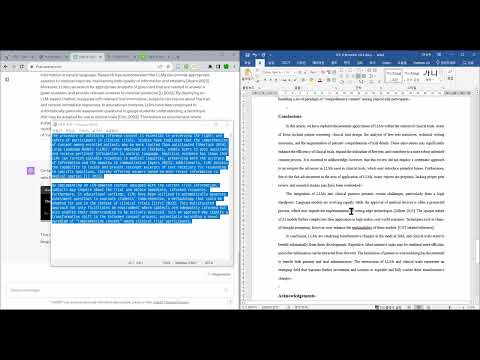
요약
이 영상은 대규모 언어 모델의 임상시험 활용을 다룬 리뷰 논문을 작성하고 수정하는 5일차 작업을 기록한다. 핵심 내용은 초고를 출력해 빨간 펜으로 검토한 뒤 MS Word, Obsidian, ChatGPT를 사용해 반복적으로 문장과 문단을 수정하는 인간 참여형 학술 글쓰기 과정이다. 초고는 환자 선별과 시험 매칭, 임상시험 설계, 비정형 및 표 형식 자료 처리, 기술 문서 작성, 설명 동의 지원에서 대규모 언어 모델의 활용 가능성과 과제를 다룬다.
핵심 내용
- 저자는 출력물을 검토하면서 작성자의 관점에서 객관적인 독자의 관점으로 전환하려고 하며, 문장 명료성, 구조, 어조를 반복적으로 점검한다.
- 학술 편집을 위해 대규모 언어 모델에 과장되지 않고 절제된 문체, 긴 문단의 재구성, 여러 문장 표현의 제시, 일반 문서 편집기에 맞춘 서식 제한 등을 요청한다.
- 초고에서 다루는 임상시험 활용 사례에는 자격 기준 추출과 환자 사전 선별, 시험 문헌 요약과 프로토콜 구성, 의료 기록의 표준 진단 코드 분류, 퇴원 요약과 영상의학 보고서 작성, 대화형 설명 동의 지원이 포함된다. 설명 동의 지원은 참여자의 질문에 답하고 이해도를 평가하며 정보 수준을 조정하는 방식으로 제시된다.
- 권장 독자
- 임상약리학 연구자, 임상시험 연구자, 생물통계학자, 의료 인공지능 연구자, 학술 논문 작성과 수정 과정을 배우는 학생
- 범위와 한계
- 이 자료는 특정 리뷰 논문의 작성 및 수정 과정을 보여 주는 영상의 증거 메모에 기반하며, 해당 논문의 체계적 문헌고찰 방법이나 임상시험에서의 대규모 언어 모델 성능을 직접 검증한 연구 결과를 제공하지 않는다. 영상에서 언급된 대규모 언어 모델의 환각, 부정확성, 설명 가능성 부족, 규제와 법적 불확실성, 임상 검증 필요성도 명시적인 한계로 제시된다.
- 연구 맥락
- 이 주제는 임상시험과 의료 인공지능에서 대규모 언어 모델, 비정형 임상자료 처리, 인간 참여형 검증을 연결하는 의료 데이터과학의 학술적 관심과 관련된다.
Summary
This video documents day five of drafting and revising a review paper on the use of large language models in clinical trials. Its main focus is a human-in-the-loop academic writing workflow in which printed drafts are marked with a red pen and then revised iteratively with MS Word, Obsidian, and ChatGPT. The draft addresses potential applications and challenges of large language models in patient screening and trial matching, clinical trial design, processing of free-text and tabular data, technical documentation, and informed consent support.
Key points
- The speaker uses printed manuscripts to shift from the perspective of a writer to that of an objective reader, repeatedly checking clarity, structure, and tone.
- For academic editing, the language model is prompted to produce a more restrained and formal style, restructure long paragraphs, offer multiple wording options, and follow formatting constraints suitable for standard word processors.
- The draft discusses eligibility-criteria extraction and patient prescreening, trial-literature summarization and protocol synthesis, classification of medical records into standard diagnostic codes, drafting of discharge summaries and radiology reports, and interactive informed-consent support. The consent application is described as answering participant questions, assessing comprehension, and adapting information to individual literacy levels.
- Audience
- Clinical pharmacology researchers, clinical trialists, biostatisticians, healthcare artificial intelligence researchers, and students learning academic manuscript drafting and revision
- Scope and limitations
- The source is an evidence summary of a video demonstrating the preparation and revision of a review paper. It does not provide a systematic-review methodology or directly validate the performance of large language models in clinical trials. The video also identifies hallucinations and inaccuracy, limited explainability, regulatory and legal uncertainty, and the need for clinical validation as important limitations.
- Research context
- The topic has a neutral thematic connection to medical data science through its focus on large language models in clinical trials, unstructured clinical data processing, and human-in-the-loop validation.