Video
LLM을 활요한 연구분야 주제분석 실습 - ChatGPT API, Embeddings API, Pubmed API
YouTube에서 보기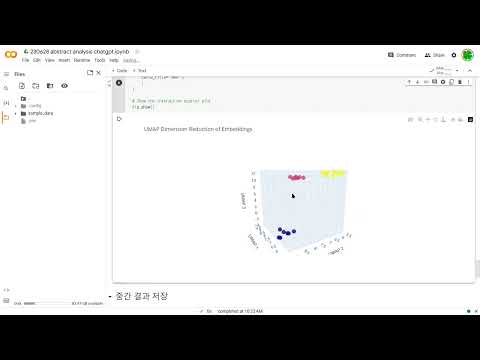
의료 AI 및 데이터과학 · Medical AI & Data Science
요약
이 영상은 PubMed 문헌 검색, OpenAI 텍스트 임베딩, 차원 축소, 군집화, 대규모 언어 모델을 결합하여 학술 문헌의 주제와 연구 동향을 자동으로 분석하고 보고하는 실습을 설명한다.
핵심 내용
- Biopython의 Bio.Entrez를 사용해 PubMed를 검색하고, 초록이 없거나 형식이 표준적이지 않은 기록을 제외한 뒤 PMID, 연도, 제목, 초록, 저자, 학술지 정보를 Pandas DataFrame으로 정리한다.
- gpt-3.5-turbo로 각 초록을 두 줄의 간결한 요약으로 축약하고, text-embedding-ada-002를 사용해 1536차원 벡터를 생성한다.
- UMAP으로 임베딩을 3차원으로 축소하고 Plotly로 대화형 시각화를 수행한다. 소규모 자료에서는 n_neighbors를 경험적으로 조정하며, 예시에서는 3으로 설정했다.
- 권장 독자
- 학술 연구자, 의학교육자, 데이터 분석가, Python과 AI 도구를 활용해 문헌 탐색과 주제 분석을 수행하려는 학생을 대상으로 한다.
- 범위와 한계
- 예시 검색은 Medical Education ChatGPT를 주제로 PubMed에서 30개 기록을 검색하고, 유효한 2023년 논문 24개를 분석했다. K-means 군집 수는 3으로 설정했으며, 군집 주제는 의료교육에서의 ChatGPT 활용, AI 생성 콘텐츠의 윤리적 고려, 의학교육에서의 AI 언어 모델로 명명되었다. 분석 결과와 시각화 자료는 CSV, Parquet, 대화형 3차원 HTML 파일로 내보낼 수 있다. 한계로는 API 사용 비용, 초록 누락과 언어 및 형식 문제, UMAP의 수동 하이퍼파라미터 조정 필요성, 시각적 판단에 의존한 K-means 군집 수 결정, 엄격한 프롬프트가 없을 때 발생할 수 있는 비일관적인 LLM 출력이 제시되었다.
- 연구 맥락
- 이 내용은 Sangzin Ahn의 포트폴리오와 관련된 의료 문헌 분석, 자연어 처리, 임베딩 기반 데이터과학, AI 활용 연구 탐색이라는 주제적 맥락에 해당한다.
Summary
This video presents a practical workflow for automating academic literature topic analysis and trend reporting by combining PubMed retrieval, OpenAI text embeddings, dimensionality reduction, clustering, and large language models.
Key points
- PubMed records are retrieved with Biopython Bio.Entrez, filtered for missing abstracts or nonstandard formatting, and organized in a Pandas DataFrame with PMID, year, title, abstract, author, and journal fields.
- Each abstract is condensed into a two-line summary with gpt-3.5-turbo, and text-embedding-ada-002 is used to create 1536-dimensional vector representations.
- UMAP reduces the embeddings to three dimensions for interactive Plotly visualization. For small datasets, n_neighbors is adjusted empirically, and it was set to 3 in the demonstration.
- Audience
- The intended audience includes academic researchers, medical educators, data analysts, and students who want to use Python and AI tools for literature exploration and thematic analysis.
- Scope and limitations
- The demonstration searched PubMed for Medical Education ChatGPT, retrieving 30 records and retaining 24 valid publications from 2023. K-means was set to three clusters, labeled ChatGPT in healthcare education, ethical considerations in AI-generated content, and AI language models in medical education. Intermediate results and visualizations can be exported as CSV, Parquet, and standalone interactive three-dimensional HTML files. Stated limitations include API costs, missing abstracts and language or formatting issues, the need to manually tune UMAP hyperparameters, selection of the K-means cluster count by visual inspection, and inconsistent LLM outputs when prompts do not impose strict formatting constraints.
- Research context
- The content has a thematic connection to Sangzin Ahn's portfolio through medical literature analysis, natural language processing, embedding-based data science, and AI-assisted research exploration.