Video
ChatGPT를 활용한 논문 읽고 쓰기 - 윤리적 창의적 활용법
YouTube에서 보기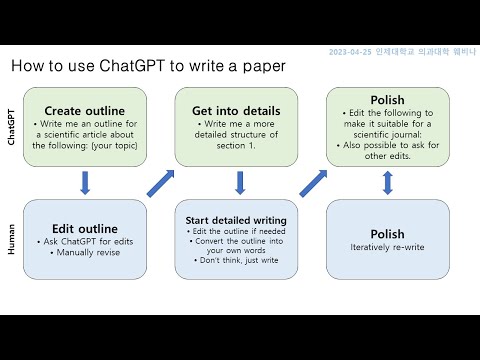
교육 및 공중보건 · Education & Public Health
요약
이 2023년 의과대학 웨비나는 의학 연구자와 학생이 ChatGPT와 관련 인공지능 도구를 논문 읽기와 쓰기에 윤리적이고 창의적으로 활용하는 방법을 설명한다. 발표는 대규모 언어 모델의 작동 원리, 문헌 검토와 PDF 분석 도구, 논문 작성 지원 절차, 학습과 지식 관리 방법을 다루며, 인공지능의 결과를 인간이 검증하고 책임져야 한다는 점을 강조한다.
핵심 내용
- 대규모 언어 모델은 주어진 문맥에서 다음 토큰의 조건부 확률을 계산하며, Transformer 구조와 자기지도 사전학습을 기반으로 한다. 규모가 커지면 번역, 요약, 논리적 추론, 코드 생성과 같은 능력이 나타날 수 있다.
- ChatGPT의 InstructGPT 및 RLHF 절차는 지도 미세조정, 인간 평가를 이용한 보상 모델 학습, 강화학습의 단계로 설명된다.
- ChatGPT는 그럴듯하지만 허위인 정보를 생성할 수 있고, 기본 모델은 실시간 웹 검색과 내장된 사실 확인 기능을 제공하지 않는다. 존재하지 않는 논문과 서지정보를 만들어낼 수 있으므로 중요한 사실과 인용은 독립적으로 확인해야 한다.
- 권장 독자
- 의과대학 교수, 연구자, 대학원생, 의과대학생 등 학술 논문을 읽고 작성하는 학습자와 실무자를 위한 내용이다.
- 범위와 한계
- 이 자료는 2023년 4월 25일 인제대학교 의과대학 웨비나 발표에 관한 증거 메모를 요약한 것이다. 발표 당시의 도구 기능과 접근성에 기반하므로 이후의 모델과 서비스 변화에는 직접 적용되지 않을 수 있다. 사전 설문 수치는 참여자의 자기보고 응답이며, 발표에서 소개한 도구와 작성 절차의 효과를 비교 검증한 실험 결과는 아니다. 제시된 권고와 시연은 개별 연구의 사실성, 재현성, 윤리적 적절성을 입증하지 않는다.
- 연구 맥락
- 교육 및 공중보건의 관점에서 의학 연구자와 학생의 인공지능 문해력, 학술적 글쓰기, 능동적 학습, 연구윤리와 지식 관리의 연계를 보여주는 주제이다. 발표에 언급된 약물 용량 및 이상반응 예측, 의료 인공지능 교육과 같은 사례는 이 교육적 주제가 의학 데이터과학 및 약리학 연구 환경과 접점을 가질 수 있음을 보여주지만, 이 요약은 해당 연구의 성과나 개인의 기여를 평가하지 않는다.
Summary
This 2023 medical school webinar explains how researchers and students can use ChatGPT and related artificial intelligence tools ethically and creatively for reading and writing academic papers. It covers large language model mechanisms, tools for literature review and PDF analysis, a workflow for writing papers, and approaches to learning and knowledge management. It emphasizes that humans must verify AI outputs and remain responsible for them.
Key points
- Large language models calculate the conditional probability of the next token in context and are based on Transformer architectures and self-supervised pretraining. As model scale increases, abilities such as translation, summarization, logical inference, and code generation may emerge.
- The InstructGPT and RLHF pipeline for ChatGPT is described as supervised fine-tuning, reward-model training using human rankings, and reinforcement learning.
- ChatGPT can generate plausible but false information and the base model does not provide live web access or built-in fact checking. It may fabricate papers and bibliographic details, so important facts and citations require independent verification.
- Audience
- The material is intended for medical faculty, researchers, graduate students, medical students, and other people who read and write scholarly papers.
- Scope and limitations
- This summary is based on evidence notes from a webinar held at Inje University College of Medicine on April 25, 2023. Tool capabilities and access described at that time may not apply directly to later models and services. The presurvey figures are self-reported participant responses, and the presentation did not provide a comparative experimental evaluation of the effectiveness of the tools or writing workflow. The recommendations and demonstrations do not establish the factual accuracy, reproducibility, or ethical suitability of any individual research output.
- Research context
- From an education and public health perspective, the presentation connects artificial intelligence literacy, academic writing, active learning, research ethics, and knowledge management for medical researchers and students. Examples involving drug-dose and adverse-effect prediction, medical artificial intelligence education, and related tools indicate possible links between this educational theme and pharmacology or medical data science settings, but this summary does not evaluate any research outcome or individual contribution.