Video
230915 리뷰논문작성 브이로그 마지막 - 리비전 과정에서 ChatGPT 활용
YouTube에서 보기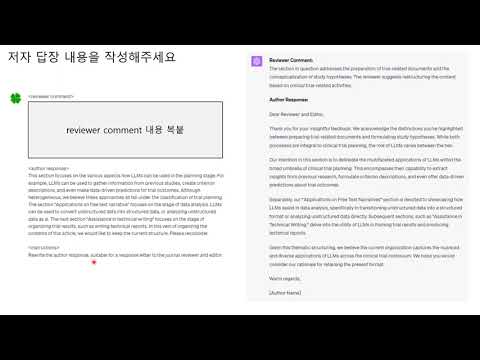
의료 AI 및 데이터과학 · Medical AI & Data Science
요약
이 영상은 학술 논문의 동료심사 수정 단계에서 대규모 언어 모델, 특히 ChatGPT를 활용하는 실무적 작업 흐름을 설명한다. 주요 활용 사례는 표 재구성, 원고 내용의 삽입과 강조, 심사자 의견의 해석 및 구조화, 편집자와 심사자에게 보내는 답변서 초안 작성이다.
핵심 내용
- 손상되거나 서식이 없는 표와 심사자의 수정 요구를 함께 제공하고, 마크다운 표와 같은 출력 형식을 구체적으로 지정하여 표를 재구성하는 방법을 보여준다.
- 원문, 추가할 내용, 작업 지시를 구분해 제시하고, 추가 내용을 원고에 자연스럽게 통합하면서 변경 부분을 굵게 표시하도록 요청한다. 특정 문단 뒤에 내용을 배치하는 것이 논리적으로 적절한지 반복적으로 점검할 수도 있다.
- 복잡한 심사 의견을 모델에 입력해 핵심 요구를 단순화하고, 이를 항목별로 나누며, 이해하기 쉬운 질문으로 다시 표현하도록 요청한다. 예시에는 전통적 자연어 처리와 대규모 언어 모델의 차이, 환자 친화적 정보, 기술적 기준에 관한 의견이 포함된다apa.
- 권장 독자
- 학술 논문 저자, 임상 연구자, 대학원생, 그리고 동료심사 의견에 대응하는 연구자를 위한 내용이다.
- 범위와 한계
- 제공된 내용은 영상에서 시연된 프롬프트와 작업 사례에 대한 요약이며, ChatGPT 활용이 논문 수정의 정확성이나 효율성을 객관적으로 검증했다는 연구 결과를 제시하지 않는다. 모델이 문단을 부자연스럽게 배치하거나 지나치게 형식적인 답변서 문구를 생성할 수 있으므로, 제출 전 저자의 과학적 검토와 수동 수정이 필요하다. 모델이 의도한 과학적 의미와 문체를 정확히 반영하는지도 확인해야 한다.
- 연구 맥락
- 이 내용은 의료 연구에서 대규모 언어 모델과 데이터 기반 도구를 활용해 학술 의사소통과 원고 수정 작업을 지원하는 주제와 연결된다.
Summary
This video describes practical workflows for using large language models, particularly ChatGPT, during the peer review revision stage of academic manuscripts. The main applications are restructuring tables, inserting and highlighting manuscript content, interpreting and organizing reviewer comments, and drafting response letters to editors and reviewers.
Key points
- The presenter demonstrates how to provide a distorted or unformatted table together with a reviewer request and specify an output format, such as a Markdown table, to reconstruct the table.
- By separating the original manuscript, proposed additional content, and task instructions, authors can ask the model to integrate new material into the text and highlight changes in bold. They can also iteratively check whether placing the material after a particular paragraph produces a coherent flow.
- Complex reviewer comments can be submitted for simplification, decomposition into bullet points, and reformulation as plain-language questions. The examples include distinctions between traditional natural language processing and large language models, patient-friendly information, and technical criteria.
- Audience
- The material is intended for academic authors, clinician researchers, graduate students, and other researchers responding to peer review.
- Scope and limitations
- The supplied material summarizes demonstrations and prompting practices from a video; it does not present an empirical study establishing the accuracy or efficiency of ChatGPT for manuscript revision. Model outputs may place text awkwardly or produce overly formal boilerplate, so authors must review and manually refine all generated text before submission. The scientific meaning and intended tone also require human validation.
- Research context
- The topic is thematically connected to the use of large language models and data-driven tools to support scholarly communication and manuscript revision in medical research.