Video
의사를 위한 ChatGPT 활용 사례 (2025.2)
YouTube에서 보기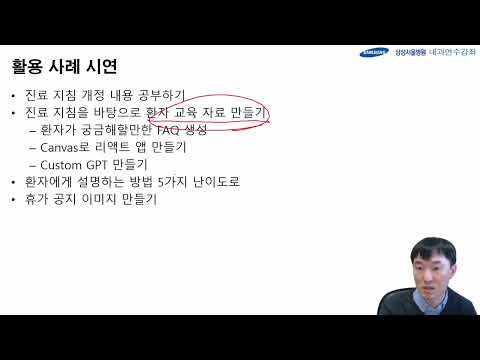
의료 AI 및 데이터과학 · Medical AI & Data Science
요약
이 영상은 의료진을 대상으로 ChatGPT-4o, Canvas, Custom GPTs, DALL-E를 임상 교육, 환자 교육, 연구 정리, 이미지 제작에 활용하는 실습 사례를 소개한다. 주요 시연은 결핵 진료지침 비교, 잠복결핵 환자 교육 자료와 FAQ 제작, 반복 업무용 맞춤형 GPT 구성, 의학 개념의 수준별 설명, 이미지 생성과 영역 편집이다.
핵심 내용
- ChatGPT-4o에 한국 결핵 진료지침 제4판과 제5판 PDF를 업로드하여 진단 기준, 약제내성 결핵 치료 요법, 잠복결핵감염 관련 변경 사항을 비교하도록 시연했다. 클로파지민의 적응증, 용량 요법, 주의사항 변화처럼 특정 약제의 세부 변경도 추가로 분석했다.
- 업로드한 지침에서 이소니아지드 단독요법에 관한 환자 교육 자료를 작성하고, 전파 위험, 치료 필요성, 치료 기간, 복용 누락, 식이 제한, 간기능 모니터링 등을 포함한 빈발 질문 10개를 생성했다.
- Canvas에서 React 코드를 작성하여 잠복결핵 FAQ 아코디언 앱을 만들고, 자연어 프롬프트로 색상과 디자인을 수정하는 과정을 보였다. 생성된 도구의 공유와 계정 사용자의 코드 수정 가능성도 설명했다. 이러한 시연은 실제 배포 환경의 안전성이나 성능 검증을 제시한 것은 아니다.
- 권장 독자
- 의사, 임상 전문의, 전공의, 의학교육자, 의료 연구자 등 의료 업무와 교육에서 생성형 AI 활용을 검토하는 독자
- 범위와 한계
- 이 요약은 제공된 영상의 증거 노트에만 근거한다. 영상은 실습 중심의 사례를 제시하며, 생성 결과의 정확도, 환자 안전성, 개인정보 보호, 임상적 유효성, 장기적 업무 효과에 대한 체계적 평가나 비교 연구 결과를 제공하지 않는다. 파일 분석은 첨부 기능을 지원하는 특정 모델이 필요하고, Canvas의 코드 생성에는 시간이 걸릴 수 있다. 이미지 생성 모델은 정확한 수량과 공간 배치에 취약하며, 복잡한 편집은 정밀도가 낮아 수동 후처리가 필요할 수 있다.
- 연구 맥락
- 이 자료는 의료 인공지능, 문서 기반 지식 추출, 임상 교육용 생성형 AI, 의료 데이터과학 도구의 실제 적용이라는 주제에서 Sangzin Ahn의 연구 및 교육 포트폴리오와 주제적으로 연결된다.
Summary
This video presents practical demonstrations of ChatGPT-4o, Canvas, Custom GPTs, and DALL-E for clinical education, patient education, research organization, and image production. The main demonstrations cover comparative analysis of tuberculosis guidelines, creation of latent tuberculosis patient education materials and FAQs, configuration of Custom GPTs for repetitive tasks, graduated explanations of medical concepts, and image generation with region editing.
Key points
- ChatGPT-4o was used to compare PDF versions 4 and 5 of the Korean tuberculosis guidelines, including changes in diagnostic criteria, drug-resistant tuberculosis regimens, and latent tuberculosis infection guidance. The demonstration also examined detailed changes for clofazimine, such as indications, dosing regimens, and precautions.
- The uploaded guideline content was used to draft patient education material for isoniazid monotherapy and to generate 10 frequent patient questions covering transmission risk, the need for treatment, treatment duration, missed doses, dietary restrictions, and liver function monitoring.
- Canvas was used to write React code for a latent tuberculosis FAQ accordion application, with color and design changes made through natural language prompts. The presentation also described sharing the generated tool and allowing account holders to modify its code. These demonstrations did not provide validation of deployment safety or performance in real clinical settings.
- Audience
- Physicians, clinical specialists, resident physicians, medical educators, and healthcare researchers considering generative AI for clinical work and education
- Scope and limitations
- This summary is based only on the supplied evidence notes from the video. The presentation is demonstration-oriented and does not report systematic evaluations or comparative study results for output accuracy, patient safety, privacy protection, clinical effectiveness, or long-term workflow impact. Document analysis requires a model that supports file attachments, and generating code in Canvas may take noticeable time. Image-generation models may struggle with exact quantities and spatial placement, while complex edits may lack sufficient fidelity and require manual post-processing.
- Research context
- The material is thematically connected to Sangzin Ahn's research and educational portfolio through its focus on applied medical AI, document-based knowledge extraction, generative AI for clinical education, and medical data science tools.