Video
대학생들은 AI챗봇을 어디에 쓰는가? (2025.4)
YouTube에서 보기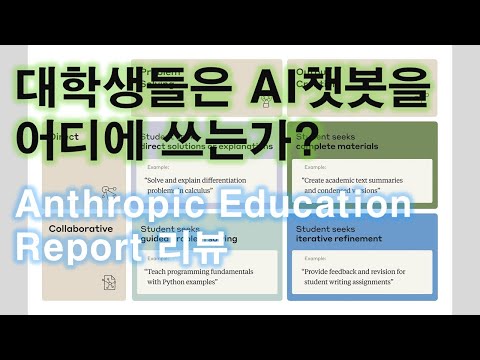
교육 및 공중보건 · Education & Public Health
요약
이 영상은 2025년 4월 Anthropic의 교육 보고서 How University Students Use Claude를 바탕으로 대학생들이 Claude 챗봇을 어떤 학업 활동에 사용하는지 설명한다. 약 100만 건의 고등교육 관련 대화에서 추출한 약 547,740건의 대학 관련 대화를 Clio라는 개인정보 보호 분석 시스템으로 분석하여 사용 목적, 전공별 분포, 상호작용 방식, 인지 과제 위임 양상을 제시한다.
핵심 내용
- 학생 사용의 주요 목적은 교육 콘텐츠의 생성과 개선 39.3%, 설명 및 과제 문제 해결 33.5%, 데이터 분석과 코딩 11.0%, 연구 설계와 도구 개발 6.5%, 도표와 순서도 생성 3.2%, 번역과 언어 수정 2.4%였다.
- Claude 사용에서 컴퓨터과학 전공은 미국 학사 학위 비율 약 5.4%에 비해 38.6%로 크게 높았고, 자연과학 및 수학도 학위 비율 약 9.2%보다 높은 13.2%였다. 경영학, 보건 전문직, 인문학은 학위 분포에 비해 낮았다.
- 상호작용은 직접적 또는 거래적 방식과 협력적 또는 대화적 방식, 문제 해결과 결과물 생성의 조합으로 분류되었다. 전체적으로 네 유형이 비교적 균형을 이루었지만, 자연과학 및 수학에서는 직접적 문제 해결이, 컴퓨터과학에서는 협력적 문제 해결이 상대적으로 두드러졌다. 교육 분야에서는 결과물 생성의 비중이 높게 나타났다. 제공된 자료에는 일부 전공별 세부 비율이 함께 제시되지만, 모든 수치의 산출 기준은 명확히 설명되지 않는다. 실제 대화 기준으로 학생 요청의 39.8%는 생성, 30.2%는 분석, 15.9%는 적용, 5.5%는 평가, 3.8%는 이해, 1.8%는 기억으로 분류되었다. 이에 따라 학생들이 챗봇에 제출하는 과제에는 기억이나 이해보다 생성과 분석 같은 고차 인지 활동이 많이 포함되었다고 해석되었다. 보고서에서 언급된 대응 방향은 정답을 즉시 제공하기보다 소크라테스식 질문, 핵심 개념 강조, 구조화된 서식과 단계적 지원을 사용하는 학습 모드와 인간과 AI의 협력적 과제 및 AI 결과 비판 활동이다. 구두 또는 상호작용형 평가가 학생의 실제 이해를 확인하는 방식으로 확대될 가능성도 제시되었다.
- 권장 독자
- 고등교육 교수, 수업 설계자, 교육정책 담당자, 교육기술 연구자, 대학 행정가를 위한 내용이다.
- 범위와 한계
- 이 분석은 Claude 사용자를 대상으로 하므로 전체 대학생의 생성형 AI 사용을 대표하지 않을 수 있다. Clio의 자동 분류는 사용자 의도나 학문 분야를 잘못 분류할 수 있으며, 기관 이메일 기반 필터는 학생 외에 교직원, 교수진, 연구자를 포함했을 가능성이 있다. 자료는 18일의 단일 보존 기간에 제한되며, 학생이 챗봇에 제출한 과제와 실제 학습 또는 상호작용 전후의 독립적 인지 노력은 구분하지 못한다. 또한 인간의 학습 발달을 위해 고안된 Bloom의 분류체계를 AI에 과제를 위임하는 현상에 적용하는 데에는 개념적 한계가 있다.
- 연구 맥락
- 이 내용은 생성형 AI가 고등교육의 학습 활동과 평가 설계에 미치는 영향을 다루는 교육 및 공중보건 주제와 연결된다. 특히 대학생의 AI 사용 데이터를 해석하고 인간과 AI의 협력적 학습 방식을 설계하는 데 관련된 주제이다.
Summary
This video discusses Anthropic's April 2025 education report, How University Students Use Claude, to describe how university students use the Claude chatbot for academic activities. Using Clio, a privacy-preserving analysis system, the report examined approximately 547,740 university-related conversations selected from about one million higher-education conversations and described usage purposes, disciplinary distributions, interaction styles, and the delegation of cognitive tasks.
Key points
- The main purposes were creating and improving educational content at 39.3%, explanations and assignment problem-solving at 33.5%, data analysis and coding at 11.0%, research design and tool development at 6.5%, diagram and flowchart creation at 3.2%, and translation and language revision at 2.4%.
- Computer science was strongly over-represented, accounting for 38.6% of Claude use compared with about 5.4% of US bachelor's degrees. Natural sciences and mathematics were also over-represented at 13.2% compared with about 9.2% of degrees. Business, health professions, and humanities were under-represented relative to their degree distributions.
- Interactions were classified by combining direct or transactional versus collaborative or dialogic modes with problem-solving versus output-creation goals. The four types were broadly balanced overall, while direct problem-solving was relatively prominent in natural sciences and mathematics and collaborative problem-solving was relatively prominent in computer science. Education showed a high share of output creation. The supplied notes also provide some discipline-specific percentages, but do not clearly explain the denominator or calculation basis for every figure. Based on actual conversations, 39.8% of requests were classified as creating, 30.2% as analyzing, 15.9% as applying, 5.5% as evaluating, 3.8% as understanding, and 1.8% as remembering. Thus, the submitted tasks included more higher-order activities such as creating and analyzing than lower-order activities such as remembering and understanding. The discussed responses include a learning mode that uses Socratic questions, emphasis on core concepts, and structured templates or scaffolding rather than immediate complete answers, as well as human-AI collaborative assignments and critique of AI outputs. The video also notes that oral or interactive assessments may become more important for checking authentic understanding.
- Audience
- The content is intended for higher-education faculty, instructional designers, education policymakers, educational technology researchers, and university administrators.
- Scope and limitations
- The analysis concerns Claude users and may not represent university students' generative AI use as a whole. Automated classification through Clio may have misclassified user intent or academic domains, and filtering by institutional email addresses may have included staff, faculty, or researchers in addition to students. The data were limited to a single 18-day retention window and cannot distinguish the tasks submitted to the chatbot from the amount of learning or independent cognitive effort before, during, or after the interaction. Applying Bloom's Taxonomy, originally developed to describe human learning progression, to the delegation of tasks to AI also has conceptual limitations.
- Research context
- The content connects thematically with education and public health through its focus on how generative AI affects higher-education learning activities and assessment design. It is particularly relevant to interpreting student AI-use data and designing collaborative learning practices involving humans and AI.