Video
연구에 Agent가 다가온다 (2025.3)
YouTube에서 보기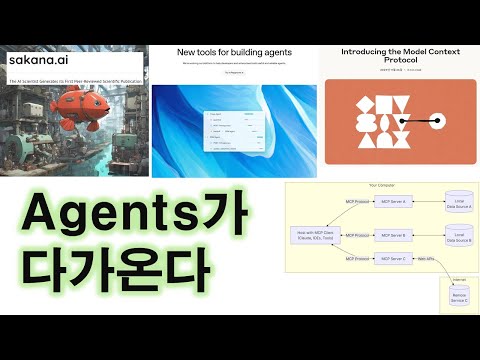
의료 AI 및 데이터과학 · Medical AI & Data Science
요약
이 영상은 자율형 AI 에이전트와 자동화된 과학 연구 시스템의 최근 발전을 설명한다. Sakana AI의 The AI Scientist, OpenAI의 에이전트 구축 도구, Anthropic의 Model Context Protocol을 중심으로 아이디어 생성부터 실험, 논문 작성, 검토까지의 자동화 흐름과 인간 연구자의 역할 변화를 논의한다.
핵심 내용
- Sakana AI의 The AI Scientist는 대규모 언어 모델을 사용해 연구 아이디어를 생성하고 Semantic Scholar로 신규성을 확인한 뒤, 아이디어를 평가하고 보관하는 파이프라인을 제시한다.
- 이 시스템은 실험 템플릿과 코드를 작성 및 수정하고, 실험을 실행하며, 수치 자료와 도표를 분석하고, 표준 형식의 논문 초안과 인용을 생성한 뒤, 언어 모델 기반 검토를 통해 초안을 반복적으로 개선한다.
- ICLR 2025 워크숍 실험에서는 사전 승인과 기관 연구윤리 심의 절차에 따라 AI 생성 논문 3편이 인간 제출 논문 40편과 함께 익명으로 심사되었다. 한 논문은 평균 심사 점수 6.33으로 워크숍 제출 논문의 상위 약 45퍼센트에 해당하며 합격 기준을 넘었고, 나머지 두 편은 기준을 충족하지 못했다. 사전 합의된 실험 및 공개 규정에 따라 AI 생성 논문은 심사 후 모두 철회되었다. 이는 워크숍 수준의 결과이며, 해당 영상의 자료는 이를 일반적인 학술적 성능으로 확장하지 않는다. 특히 더 높은 수준의 학회 기준으로 분석했을 때 인용 출처의 오류와 부정확한 수학적 정의가 확인되었다. 예를 들어 LSTM의 기원을 Goodfellow 등, 2016으로 잘못 제시한 사례가 언급되었다. 결국 이 시스템은 논문 초안과 실험을 빠르게 생성할 수 있지만, 과학적 타당성과 정확성은 별도로 검증되어야 한다는 한계가 제시된다.
- 권장 독자
- 대학원생, 의료 AI 및 데이터과학 연구자, 소프트웨어 엔지니어, 기계학습 실무자, 자동화된 과학적 발견과 대규모 언어 모델 에이전트에 관심 있는 독자
- 범위와 한계
- OpenAI의 Responses API는 대화 기능과 웹 검색, 벡터 저장소 기반 파일 검색, 컴퓨터 사용 도구를 하나의 인터페이스로 결합한다. Agents SDK는 사용자 지침과 도구를 설정한 에이전트, 다중 에이전트 오케스트레이션과 인계, 입력 및 출력 검증, 실행 추적을 지원한다. Anthropic의 Model Context Protocol은 자연어 인터페이스와 데이터베이스, 파일 시스템, 웹 API 같은 도구 서버를 표준화된 클라이언트 서버 구조로 연결한다. 영상은 이러한 구조가 연구 자동화와 실제 실험실 자동화로 확대될 경우 인간 연구자의 역할이 계획, 감독, 검증 중심으로 이동할 수 있다고 논의하지만, 순수하게 자동화된 논문의 윤리 기준, 저자 기준, 심사 지침에 대해서는 아직 과학계의 합의가 없다고 명시한다. 제시된 근거는 특정 워크숍 실험, 특정 벤치마크 예시, 도구 시연에 한정되며 장기적 효과나 일반적 연구 성능을 입증하는 체계적 평가가 아니다.
- 연구 맥락
- 의료 AI 및 데이터과학에서 에이전트 기반 연구 자동화, 도구 연결 표준, 실험 재현성, 그리고 인간의 검증 및 책임 구조를 검토하는 주제와 연결된다.
Summary
The video describes recent advances in autonomous AI agents and automated scientific research systems. It focuses on Sakana AI's The AI Scientist, OpenAI's agent-building tools, and Anthropic's Model Context Protocol, discussing automation from idea generation through experimentation, manuscript preparation, and review, as well as changing roles for human researchers.
Key points
- Sakana AI's The AI Scientist uses large language models to generate research ideas, check novelty through Semantic Scholar, and score and archive candidate ideas.
- The system fills experiment templates, writes and modifies code, runs experiments, analyzes numerical data, produces plots, drafts manuscripts with citations, and uses language-model-based review to provide iterative feedback.
- In an ICLR 2025 workshop experiment, three AI-generated papers were anonymously reviewed with 40 human submissions after prior approval and institutional ethics clearance. One paper received an average reviewer score of 6.33, corresponding to approximately the top 45 percent of workshop submissions, and passed the acceptance threshold; the other two did not. Under the prespecified experimental and disclosure rules, all AI-generated papers were withdrawn after review. This was a workshop-level result, and the source does not generalize it to overall scientific performance. Analysis against higher-level conference standards identified citation-origin errors and imprecise mathematical definitions, including an example that incorrectly attributed the foundations of LSTM to Goodfellow et al., 2016. The stated limitation is therefore that the system can accelerate the generation of experiments and manuscript drafts, but scientific validity and accuracy still require separate human verification.
- Audience
- Graduate students, medical AI and data science researchers, software engineers, machine learning practitioners, and readers interested in automated scientific discovery and large language model agent frameworks
- Scope and limitations
- OpenAI's Responses API combines conversational capabilities with web search, file search through vector stores, and computer-use tools. The Agents SDK supports agents with configurable instructions and tools, multi-agent orchestration and handoffs, input and output validation, and execution tracing. Anthropic's Model Context Protocol standardizes connections between natural-language clients and tool servers for databases, file systems, and web APIs. The video discusses the possibility that expansion into real-world laboratory automation could shift human work toward planning, oversight, and validation, but states that the scientific community has not reached consensus on ethics, authorship, submission criteria, or review standards for purely or heavily AI-generated manuscripts. The evidence presented is limited to a specific workshop experiment, selected benchmark examples, and tool demonstrations; it is not a systematic evaluation of long-term effects or general research performance.
- Research context
- The topic is thematically connected to medical AI and data science through agent-based research automation, standards for connecting computational tools, reproducibility, and human verification and accountability.